Tide Table or Tide Clock: Two Ways to Keep Track of the Water
Tide table or tide clock? Compare the times, heights and cycle each displays, then choose the tool that best fits your coastal plans and routine.
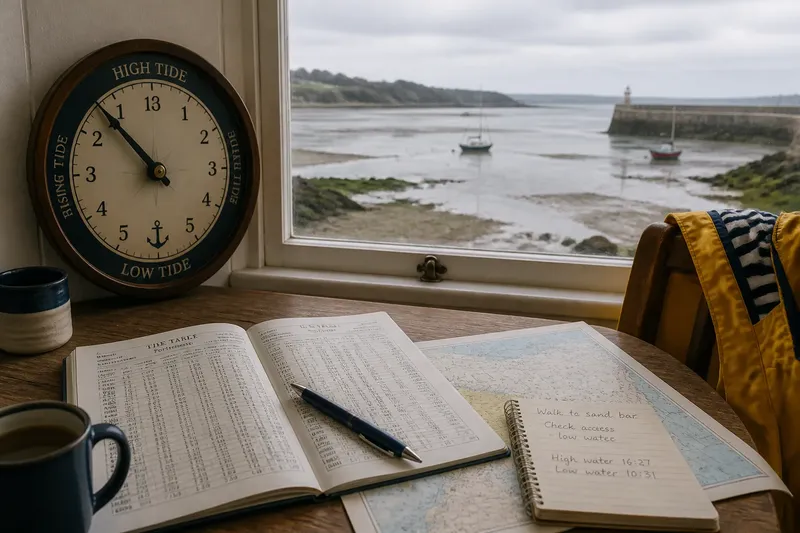
A tide table or tide clock serves different needs: one gives predicted times and heights, while the other offers a quick visual estimate of where the tide sits in its cycle. The right choice depends on whether you need to plan around a particular place and time or simply keep an eye on the changing water.
Neither tool shows the whole coastal picture. A table is useful for specific predictions; a clock makes the ebb-and-flow pattern easy to glance at. Knowing what each leaves out helps you choose without asking either to do a job it was not designed for.
What each displays
A printed tide table lists predicted high and low waters for a named location, usually by date and time. Many tables also give predicted heights relative to a stated chart datum. That height is a reference-based prediction, not a description of how deep the water will be at every point nearby.
A tide clock has a dial marked to show the approximate progression from high water through ebb, low water and flood. Its hand moves around the cycle, giving a broad indication of whether the tide is rising or falling and where it may be in that sequence. Most ordinary tide clocks do not display a date, a local high-water time or a predicted height.
The contrast is between detail and immediacy. A table can help answer, “When is the next high water at this station?” A clock can answer, “Is the tide broadly moving in or out?” Neither is a live gauge of the water outside your window.
Match the tool to the task
Choose a printed table if a plan depends on a particular time or predicted height. It suits someone checking a harbour departure, arranging a visit to a tidal shore, or comparing the tide on different days. Its useful details are tied to the station named in the table, so the place matters as much as the date.
Choose a tide clock if you want a visible reminder of the tide’s broad phase at home, in a coastal workplace or in a boat’s cabin. It is convenient for routine awareness: a glance may show that the cycle is moving towards high water or towards low water. It is less suitable for deciding exactly when a tide turns.
If you want both kinds of information, use the tools together. The table can anchor a plan to a local prediction; the clock can make the ongoing cycle easy to follow. Treating them as complementary is more useful than expecting one to supply the other’s detail.
Plans tied to a place
Tide tables are the clearer choice when location-specific predictions matter. A table may be published for a port or reference station, while a nearby beach, inlet or river mouth can have different local timing and water behaviour. Some tables provide adjustments for secondary locations; if yours does, follow its stated method rather than assuming the nearest station is interchangeable.
For a visit to a tidal shore, the predicted time and height can help you think through when access may change. A clock’s phase indication cannot tell you how much time remains before a route becomes cut off, or whether a particular ledge will be covered. Local shape, weather and water movement all affect what happens at the shore.
Imagine you are planning to visit a broad estuary with a narrow path beside a channel. You check the table for the named station and note its predicted high and low waters, then consult local access information to understand the path. A tide clock in the hall may remind you that the water is rising, but it cannot replace the location-specific check needed for that plan.
For activities where changing water affects access or safety, use current local guidance and allow for conditions beyond the prediction. If the consequences of getting the timing wrong are serious, seek advice from a qualified local source rather than relying on a clock or printed table alone.
Routines at home
A tide clock fits a household that wants a simple, continuous cue. Mounted somewhere visible, it can make the daily rhythm of a nearby coast more noticeable without requiring you to consult a page. This can be helpful when curiosity, rather than a precise appointment, is the reason for checking.
A printed table is better if you look up tides occasionally, plan ahead, or need to compare a run of days. It can be kept with a local chart, a notebook or other coastal information. For readers who prefer a digital display, the same decision applies: look for a source that clearly identifies its location and the kind of prediction it provides.
Think about how you will actually consult the information. A table has value only if you can find the relevant date and location when needed; a clock has value only if its setting suits the local tide cycle. Convenience is not a substitute for accuracy, but an easy-to-use tool is more likely to become part of a sensible routine.
Reading heights carefully
Predicted heights in a tide table need their reference explained. Chart datum is a mapping reference used for water depths; it is not the same as the visible shore, the depth under a boat or a universal measure of water level. The meaning of a number depends on the datum and location stated by the source.
A tide clock ordinarily conveys phase rather than height. Its hand cannot tell you whether high water will be unusually high or low compared with another day, and it cannot show the depth over a particular shoal. If height is relevant to a decision, consult a suitable local table or prediction that states its reference.
Actual water can differ from a prediction because tides are not the only influence on sea level. Wind, atmospheric pressure and local conditions may affect what you observe. A prediction is a planning aid, not a promise of the exact waterline at every moment.
Setting a tide clock
A tide clock is usually set to follow the local cycle between successive high waters. That cycle is close to a lunar day rather than an ordinary day, so a conventional clock mechanism will not track it correctly. The clock’s instructions explain how to set its hand and whether it needs a location-specific adjustment.
Not every coast follows an uncomplicated pattern of two similar high waters and two similar low waters each day. Local tidal regimes vary, and a simple clock may represent them only approximately. Before choosing one, check whether its design is intended for the kind of tide experienced at your location.
Where the tide pattern is irregular or strongly affected by local geography, a clock may be an attractive visual reminder but a poor source of precise timing. Use a table or other appropriate local prediction for the detail the clock cannot provide.
Questions readers ask?
Does a tide clock show the next high tide?
Usually it shows the approximate phase of the cycle, not a dated time for the next high water. Consult a local tide table when you need a specific prediction.
Can I use a tide table for a nearby beach?
Only if the table or its accompanying guidance covers that beach or gives a stated way to adjust from its reference station. Nearby places can differ in timing and tidal behaviour, so do not assume they match.
Which is easier for everyday use?
A tide clock is quicker to read at a glance, while a table takes a moment to check but provides more detail. Choose according to whether your routine needs broad awareness or date-specific information.
Can a tide clock replace a tide table?
No, not when you need predicted times or heights for a particular place and date. It can complement a table by making the broad rising-and-falling cycle visible between checks.
A clear choice
For precise planning, choose a tide table that names the relevant location and explains its height reference. For an at-a-glance sense of the cycle, choose a tide clock suited to the local tidal pattern. If both descriptions fit your life, keeping both is a straightforward option.
Before relying on either, check that you have the right location and understand what the display represents. The practical difference between a tide table or tide clock is simple: one helps you consult a prediction; the other keeps the rhythm of the tide in view.
Make the tool match the question you need answered. A clock is a reminder, a table is a location-based prediction, and neither replaces attention to the conditions at the shore.